



SHOPPING CART
Your cart is empty.
shop now
Your cart is empty.
shop now
Many who enter polymer analysis get stuck at the first step—selecting a DSC sample pan. Starting right can save hours of frustration and unclear results.
For beginners, DSC sample pans are essential for holding polymer samples during analysis, and their proper selection determines the accuracy and clarity of thermal transition data such as melting or glass point.
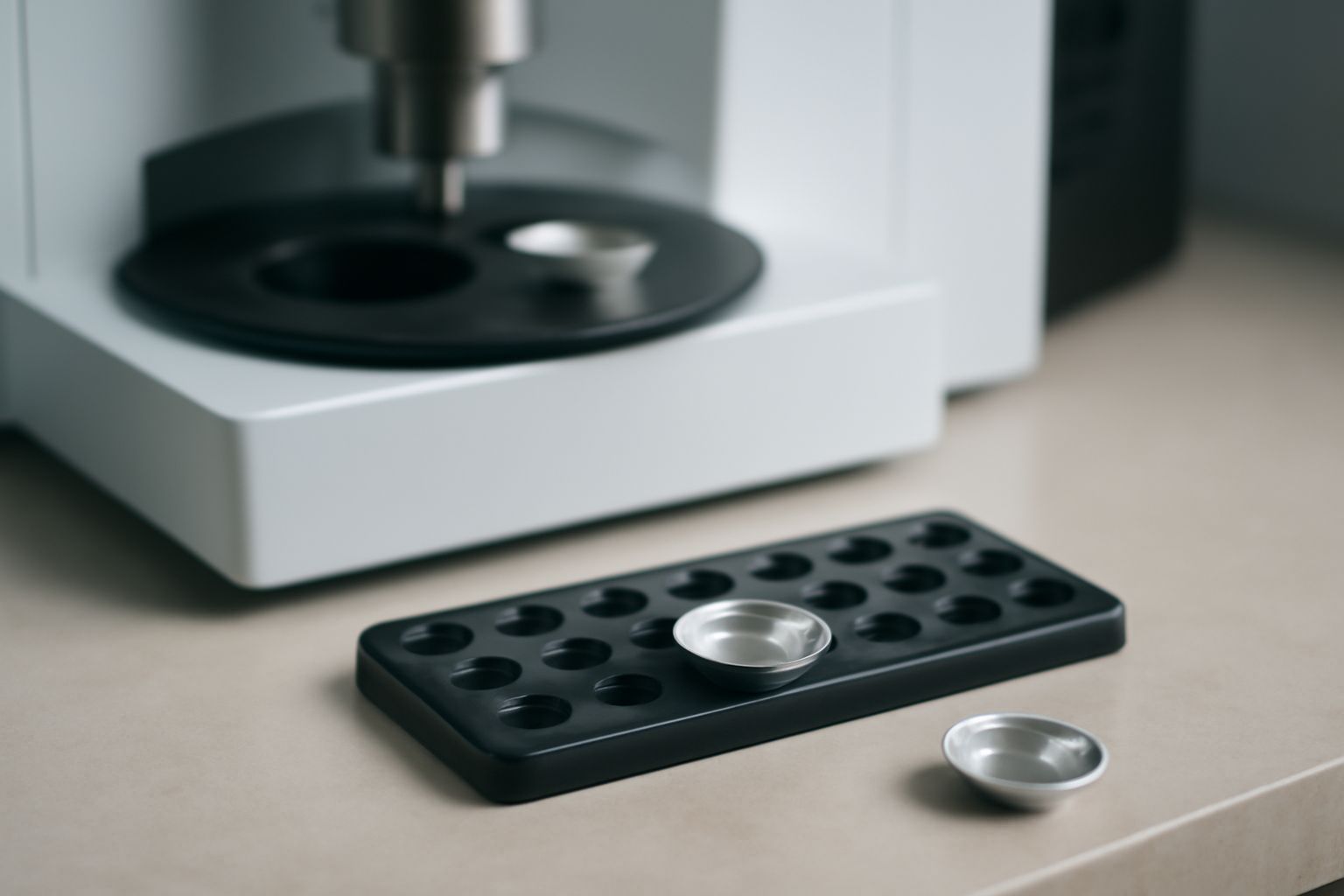
It took me several months to realize my blurry data often resulted from a mismatched pan, not the machine or sample itself. By focusing on pan type, I improved consistency and reduced repeat errors. Newcomers benefit most when the basics become second nature.
Polymer testing can overwhelm beginners with technical terms and equipment. DSC stands out as a foundational method, but its setup and workflow can be confusing.
Differential Scanning Calorimetry (DSC) measures how a polymer reacts to increasing or decreasing temperature, especially its melting, crystallization, or glass transition—using a sensitive balance and a sample in a pan.
| Key Term | What It Means | Why It Matters |
|---|---|---|
| DSC | Instrument for measuring thermal events | Helps identify melting, glass, and crystallization points (DSC info) |
| Sample Pan | Holder for the polymer sample in analysis | Directly touches sample, impacts heat transfer |
| Transition | Change (melt, glass) when polymer gains/loses heat | Shows up as a peak or dip on DSC result plot |
| Baseline | DSC signal before/after main transition | Should be flat; noise = bad pan/sample setup |
Over time, I found it best to view the pan as part of the instrument—a low-quality or wrong-fit pan can distort or hide a polymer’s true properties. All reliable DSC results start with the pan chosen in step one of polymer analysis protocols.
Choosing your first sample pan can feel like guesswork. Picking the wrong one leads to weak signals and wasted time repeating tests.
Select an aluminum pan compatible with your DSC model, confirmed by the manufacturer, and focus on pure, clean construction with a secure seal. Start with standard volume pans for routine polymer samples.
| Step | Action | Tip |
|---|---|---|
| Find Model Match | Look up your DSC brand and models | Use model compatibility charts, often on supplier sites |
| Pick Material | Choose 99.99% aluminum for most polymers | Switch only if your sample is aggressive or high-temp |
| Check Volume | Standard (20–40 μL) for beginners | Too big or too small causes thermal error |
| Seal Selection | Start with normal or hermetic lid | Use hermetic for moisture/volatile samples (hermetic seal) |
| Ask for Sample/Support | Contact supplier for starter pack if possible | Test pan fit before bulk order |
I remember failing the first few DSC runs due to a pan not fitting my Mettler DSC tray. Getting the right fit stopped pan jams and gave me clearer test peaks. Most labs now list starter kits and clear charts as part of new user lab support.
DSC is sensitive. Even a minor mistake with sample or pan can hide a transition or produce a false result. Beginners repeat errors that more experienced users now avoid.
The most common mistakes are pan mismatch, using dirty or reused pans, overfilling, and skipping system calibration steps. These issues reduce test reliability and waste sample material.
| Mistake | Why It Is a Problem | How to Avoid |
|---|---|---|
| Mismatched Pan/Tray | Causes uneven heating, noisy baseline | Use correct pan for your DSC model |
| Dirty or Reused Pans | Contaminates next sample, makes false peaks | Use new, clean or single-use pans |
| Overfilled Pan | Spills during test, hides transitions | Fill only 60–80% of capacity |
| Skipping Calibration | Results shift, unreliable data | Calibrate DSC before each analysis |
I still check every pan visually and prep according to a checklist, making sure I cover seal, fit, and debris. Consistency brings better, more reliable results. Most of my polymer test issues disappeared by following industry SOPs that experienced users recommend for every analysis.
Some beginners focus only on the DSC settings, but the pan is the direct bridge between sample and heat. It can make or break test quality.
Sample pans influence baseline stability, transition sharpness, and data repeatability. A well-chosen pan will give clear peaks and reproducible tests across runs and operators.
| Pan Factor | Effect on Results | Newbie Advice |
|---|---|---|
| Material Purity | Reduces data noise and false transitions | Use high purity (99.99%) aluminum pans only |
| Dimensional Accuracy | Keeps baseline flat, no sensor error | Pick certified supplier; match pan to tray specs |
| Sealing Strength | Prevents sample loss, ensures consistent analysis | Tight seal for volatiles; normal for standard work |
| Batch Uniformity | Improves repeatability, fewer failed runs | Order pans in one lot for the whole project |
When I switched to a trusted brand and stopped mixing old and new lots, my results lined up run after run. Even small differences in pan shape can shift baselines or create ghost peaks. The pan choice is as important as the thermometer in any thermal analysis for polymers.
For beginners, the best polymer DSC results come by starting with the right sample pan. Learn each pan detail—material, fit, seal—and trust your supplier to support fast progress.
Get Starter Tips from REDTHERMO Support

C082.Wangdefu International Building, Furong, Changsha, Hunan, China


+86-19907415020