



SHOPPING CART
Your cart is empty.
shop now
Your cart is empty.
shop now
Finding the right DSC sample pans can be a challenge. The wrong choice can ruin accuracy and slow research down.
The best DSC sample pans for polymer analysis are made from high-purity aluminum or platinum. These pans offer strong thermal conductivity, chemical resistance, and precise sealing, ensuring consistent data for reliable polymer testing.
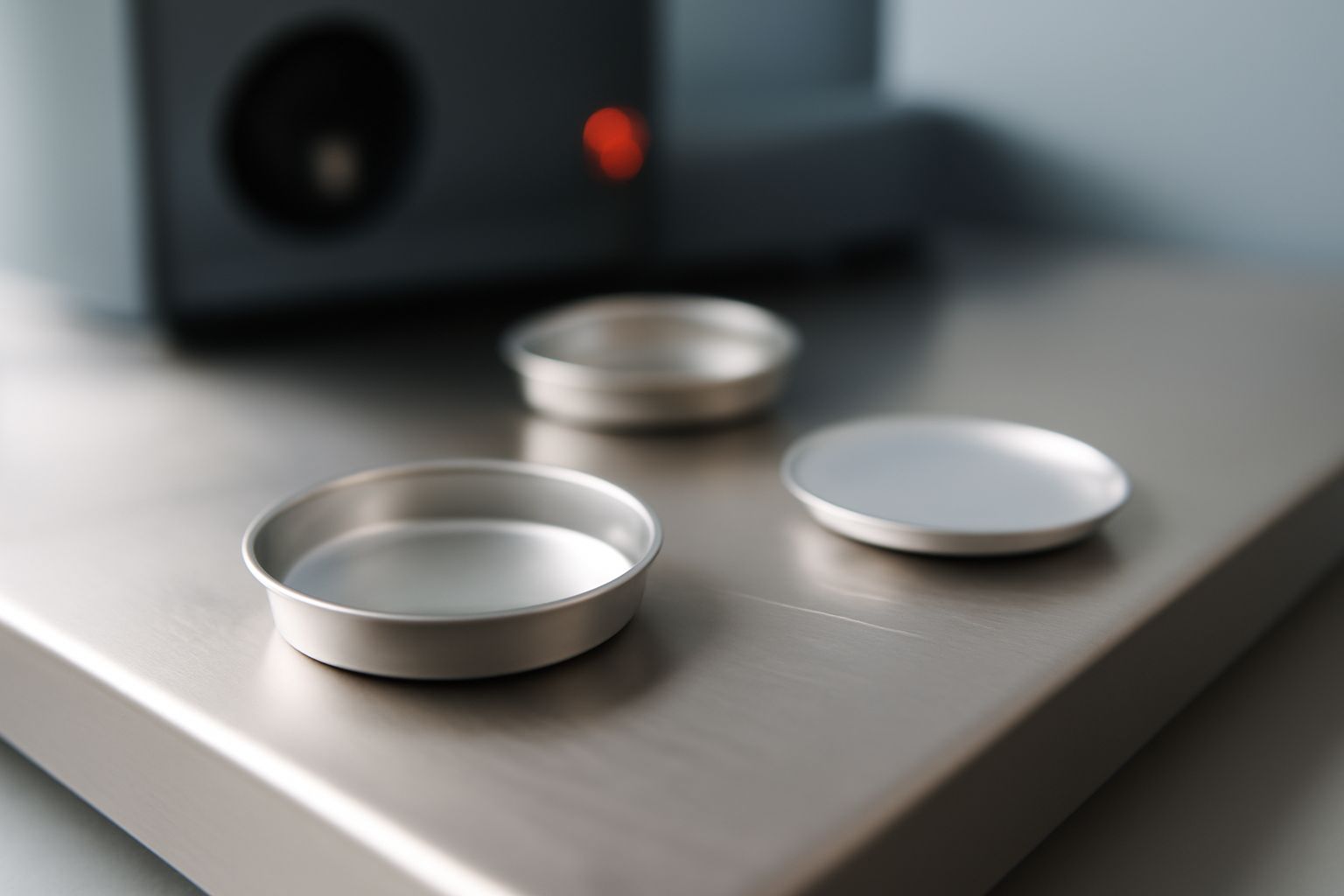
Switching pans improved my polymer experiment results quickly. When I use sample pans designed for DSC, I see sharper melting points and lower baseline drift in my data. There are many pan types, but not all give reliable transitions. Learn more by reading on below.
Polymers react to temperature changes in sensitive ways. Using the wrong pan design can lead to decomposition or faulty readings.
The key features of DSC sample pans for polymer analysis are high thermal conductivity, moisture resistance, proper sealing, and dimensional compatibility with instrument models. These features protect samples and maintain accurate thermal transitions.
| Feature | Why It Matters | Example/Explanation |
|---|---|---|
| Thermal Conductivity | It ensures fast, even heat transfer to samples for sharp polymer transitions. | Aluminum conducts heat better than most metals. Learn more |
| Sealing/Closure | Keeps samples in, blocks out moisture or oxygen for stable results. | Hermetic pans stop sample evaporation—a must for polymers that absorb water. |
| Compatibility | Pans must fit precisely for accurate calibration and baseline. | Some DSC models only accept specific pan sizes. |
| Material Purity | Reduces contamination and unknown reactions during heating. | 99.99% pure aluminum pans keep test reactions consistent. See aluminum |
| Capacity | Holds enough sample while allowing free expansion but avoids pan overload. | Most polymer DSC pans hold 20-40 μL or mg. |
Many buyers ignore material purity or tight sealing at first. After running comparative tests, I saw that sealing is the difference between crisp, repeatable glass transition points and noisy baseline jumps. I always check both purity and fit when I order pans. These pan features influence every step of differential scanning calorimetry.
Using poor-conductivity pans can flatten DSC peaks or drift the baseline. This makes polymers hard to analyze or compare.
Aluminum DSC pans benefit polymer tests due to high thermal conductivity, strong chemical inertness, easy availability, and low cost. Their reliability gives precise glass transition and melting point data.
| Property | Aluminum | Platinum | Gold |
|---|---|---|---|
| Thermal Conductivity (W/m·K) | 235 | 71.6 | 318 |
| Chemical Resistance | Strong vs. most polymers | Excellent | Excellent |
| Cost | Low | Very high | High |
| Reuse | No (often single-use) | Yes (reusable) | Sometimes |
| Typical Uses | Routine polymer, food, pharma tests | High temp, special studies | Volatile or precious samples |
For most polymer DSC runs, I use high-purity aluminum pans. These offer a good balance of price, sharp signals, and supply. Platinum and gold are preferred in extreme or special cases, but aluminum dominates for everyday throughput and repeatability.
Pans that react or degrade with its sample ruin important DSC readings. Even brands can differ in chemical resistance.
The ideal materials for DSC pans are aluminum, platinum, and sometimes gold. These maintain purity, resist polymer residues, and function across different temperature ranges for any thermal analysis model.
| DSC Pan Material | Polymer Compatibility | Max. Use Temp (°C) | Best For |
|---|---|---|---|
| Aluminum | Common polymers, organics | 600 | Wide everyday analysis |
| Platinum | All polymers, aggressive reagents | 1600 | High-temp, specialty polymers |
| Gold | Volatile, oxygen-sensitive samples | 1000 | Pharma and research use |
| PTFE or Ceramic | Certain corrosive or non-metal samples | 300 | Special case studies |
I sometimes get requests for PTFE or ceramic pans for advanced polymer blends. Still, aluminum stays the main choice for most DSC labs. Select pan material after testing it with a polymer sample in a blank run. Most international protocols for polymer characterization specify which pan material fits the job.
Sample pan selection directly impacts data. Poor pans can mask or shift melting points, affecting product quality or research.
Precision in polymer DSC analysis is improved by pans that maintain shape, provide stable baselines, and match equipment specs. Quality pans minimize baseline noise and let analysts see glass transition and melting points clearly.
| Pan Quality Factor | Resulting Effect on Polymer DSC Data | Why It Matters |
|---|---|---|
| Dimensional Accuracy | Less baseline drift | Loose pans slip and cause temperature errors |
| Purity of Material | Cleaner baseline, reduced outgassing | Impurities cause artifact peaks |
| Sealing Design | Stable results for volatile polymers | Stops sample loss in sensitive runs |
| Thermal Uniformity | Sharper transitions, higher accuracy | Non-uniform pans delay sample response |
After switching to higher-grade pans, I measured repeatable melting data for polymer blends, and there was less difference between operators. Maintaining baseline stability is a must, especially when following ISO 11357 for polymer testing. Inconsistent pans even shift results by a degree or two, risking bad decisions in R&D work.
Choosing high-purity, compatible DSC pans is key to getting precise, repeatable polymer analysis data every time.
Need Help? Contact Technical Support

C082.Wangdefu International Building, Furong, Changsha, Hunan, China


+86-19907415020