



SHOPPING CART
Your cart is empty.
shop now
Your cart is empty.
shop now
Selecting the wrong pan material or size leads to unreliable test results and wasted samples. Every thermal analysis depends on good technical choices.
When choosing DSC sample pans, you need to focus on material composition, temperature rating, and proper fit. This guarantees compatibility with your current thermal analysis equipment and leads to more accurate results every time.
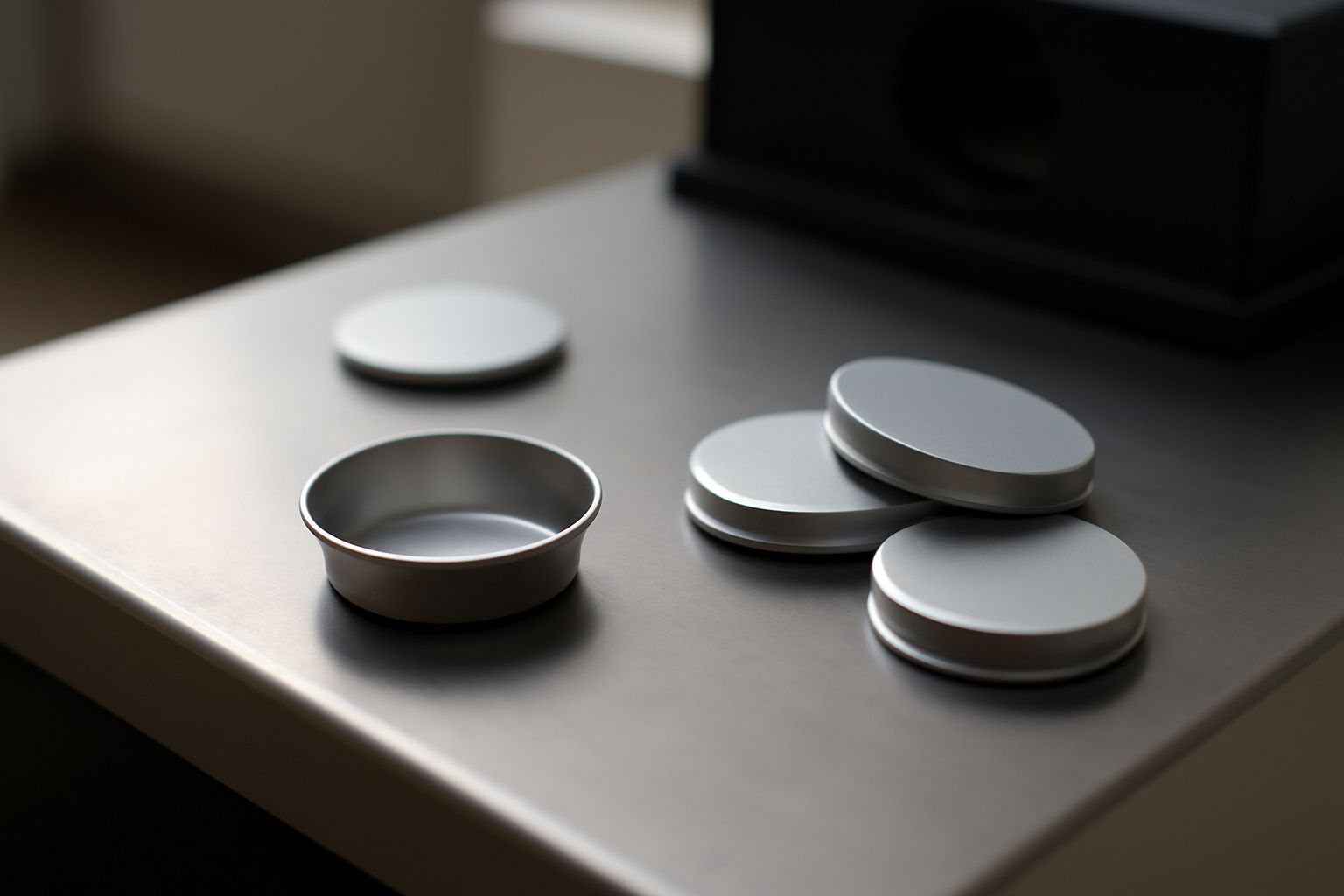
Lab teams rely on sample pans that match their analysis needs. A careful look at technical specs prevents problems, keeps tests repeatable, and saves time on troubleshooting or repeat work.
If you do not choose the right pan material, your analysis results may be unstable or inaccurate. This frustration is common in busy lab settings.
DSC sample pans are made from several core materials: high-purity aluminum, platinum, gold, and sometimes ceramics or polymers, depending on the analysis type and temperature range.
| Material | Applications | Benefits | Limitations |
|---|---|---|---|
| Aluminum (99.99%) | General organic, polymer, and pharmaceutical DSC | Low background, great heat transfer | Maximum temp ~600°C, can oxidize |
| Platinum | High temperature, precise calibration, special samples | Stable to 1600°C, non-reactive | High cost, less common for routine use |
| Gold | Special corrosive samples, sensitive measurements | Inert, excellent for baseline stability | Very expensive, can deform at high temp |
| Ceramic | Extreme temperatures, some inorganic studies | Very high temp limit, chemically inert | Heavy, lower sensitivity for small changes |
| Polymer | Low temp DSC, volatile and moisture-sensitive samples | Low mass, easy sample release | Low temp only, can absorb sample vapors |
I check test method and temperature limits before picking a pan. According to research published in Journal of Thermal Analysis and Calorimetry, using high-purity aluminum pans helps to reduce baseline drift in most polymer and pharmaceutical tests. For oxidizing samples at elevated temperature, platinum or ceramic pans prevent reaction with the vessel. Each pan material offers unique features and limitations. Deciding comes down to balancing cost, reactivity, and test sensitivity for your task.
Mismatch between your DSC pans and instrument means rejected tests, extra cost or even machine damage. Many buyers overlook this at the start.
Check pan size, depth, and lid type against your DSC model’s specification sheet. Only use pans certified as compatible with your brand, such as TA Instruments, NETZSCH, or .
| Compatibility Factor | Importance | How to Verify |
|---|---|---|
| Pan Diameter | Ensures proper fit on sensor platform | Measure and cross-check with manufacturer model charts |
| Pan Depth | Affects correct sample placement & heat transfer | Follow instrument guidelines; check high/low pan types |
| Lid or Seal | Prevents sample loss or volatile escape | Match to pan and test protocol (crimped, vented, etc.) |
| Material Code | Some systems require specific codes for auto recognition | Consult compatibility tables provided by vendors |
| Model Number | Makes ordering and inventory simple | Order DSC pans with matching brand model |
I have seen labs waste weeks troubleshooting fit problems that come from ignoring model match. Many leading sites like REDTHERMO and instrument manufacturers host public compatibility tables for quick checks. Always use the instrument technical manual and request technical support if needed. Fitting the right pan, even by a difference as small as 0.05 mm, makes real impact on test repeatability.
Exceeding your pan’s temperature limit can destroy your sample, damage the sensor, or ruin your analysis. That is a headache for every technician.
Most DSC pans handle up to 600°C for aluminum, 1600°C for platinum, and over 2000°C for some ceramics. Always select the pan type based on your test program’s thermal range.
| Pan Type | Maximum Temperature (°C) | Common Uses | Notes |
|---|---|---|---|
| Standard Aluminum | 550–600 | Organics, polymers, pharma | May oxidize in air above 600°C |
| High-temp Aluminum Alloy | 750–850 | Specialty organics, moderate oxides | Only for certain sealed systems |
| Platinum | 1600 | Metals, high-temp inorganics | Non-oxidizing, best for calibration |
| Ceramic | 2000+ | Advanced materials, extreme temp analysis | Heavier pans, rarely for routine DSC |
For polymer melting or glass transitions, standard aluminum pans suit most needs. But in academic research, I sometimes deal with refractory compounds. These require platinum or ceramic pans for higher limits. According to ’s technical guide (2023), pushing pans beyond their temperature rating can lead to inaccurate signals or rupture. Always stay within the pan’s safe limit and match your analysis profile with suitable pan material.
Confusion about pan size can interrupt automated runs or cause sensor failures. This is a costly error for labs running time-sensitive tests.
Most DSC pans follow standard diameters—6.0 mm, 6.8 mm, and 8.0 mm are common—for leading manufacturers. Depth and volume may vary by test and model.
| Manufacturer | Diameter (mm) | Depth (mm) | Volume (μL) | Typical Use |
|---|---|---|---|---|
| TA Instruments | 6.0, 6.8, 8.0 | 1.5, 3.0 | 20, 40 | DSC, TGA, SDT |
| NETZSCH | 6.8 | 1.8, 3.0 | 40 | Universal analysis |
| 6.4, 8.0 | 2.0, 3.3 | 30–40 | Routine & high-res tests | |
| Custom | User specified | Varies | Any | Special research, unique instruments |
I look up instrument manuals and product charts before bulk orders. Custom sizing is available, but orders must follow strict tolerance values. In one of my projects, a sample holder was designed for unique pans, so I provided technical drawings to the supplier. Standard sizes simplify procurement and prevent machine downtime. Most leading pan vendors publish spec sheets for exact diameter, depth, and volume, helping you place orders without error.


C082.Wangdefu International Building, Furong, Changsha, Hunan, China


+86-19907415020