



SHOPPING CART
Your cart is empty.
shop now
Your cart is empty.
shop now
Many laboratories struggle with inconsistent test results caused by ignoring sample holder specifications. I have seen wasted hours and failed experiments from poor choices.
To select suitable thermal analysis sample holders, look at material composition, temperature range, manufacturing precision, and if holders can be customized for your experiments.
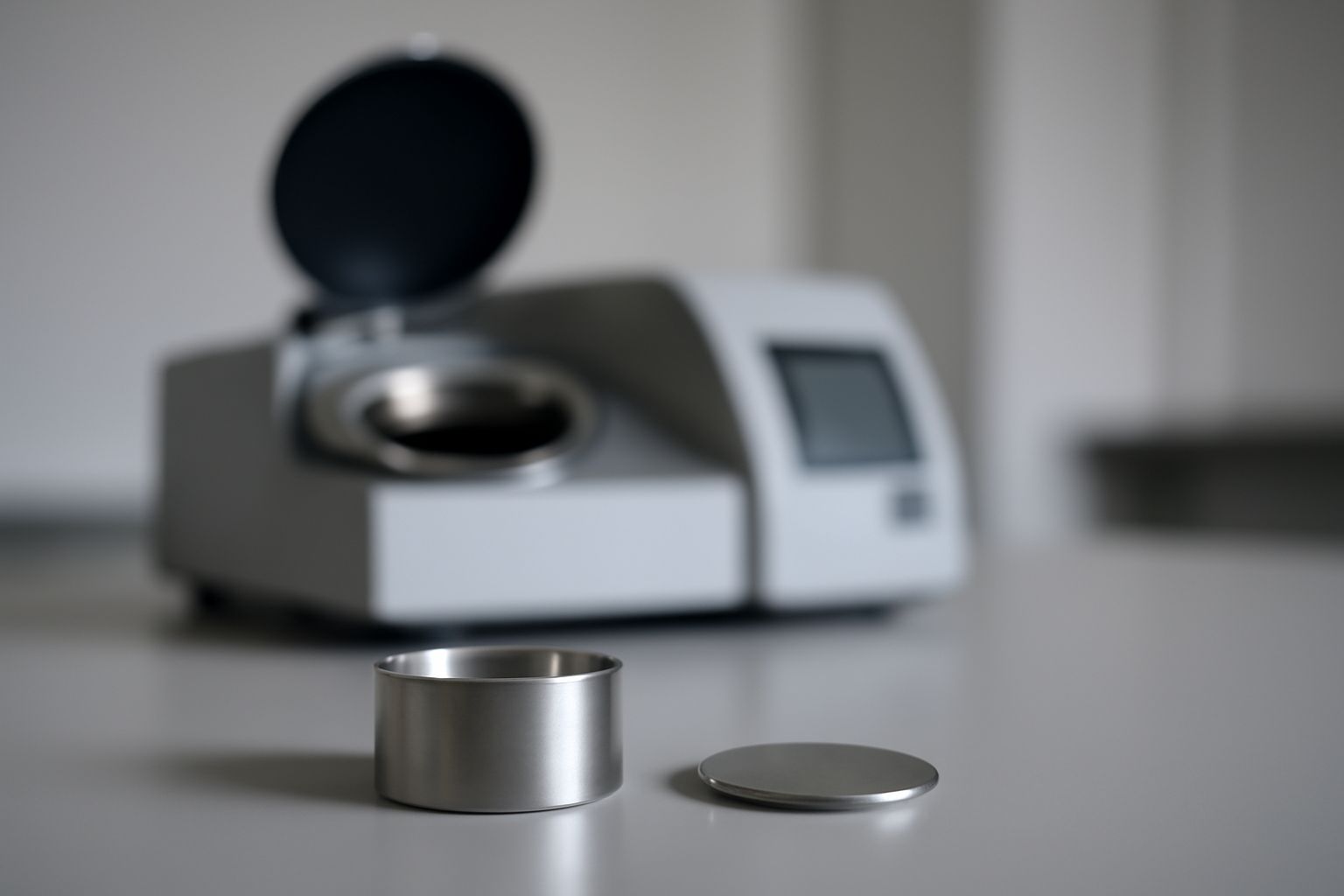
Technical specifications are the backbone of reliable laboratory work. When I started in the materials lab, I ignored spec sheets once and faced unexpected sample contamination. This taught me that every detail counts. Only when I matched holder specs to my setup did my results become stable and trusted. Here is everything I learned about what to check before purchasing.
When I chose the wrong pan material in my early testing, I saw samples react, warp, or even ruin measurements. Material choice controls holder performance.
High-quality sample holders use aluminum, platinum, ceramic, or even gold alloys depending on chemical resistance, purity needs, and your instrument’s requirements.
| Material | Max Usage Temperature | Recommended Applications | Contamination Risk |
|---|---|---|---|
| Aluminum | Up to 600°C | Calorimetry, DSC, routine thermal analysis | Very low if 99.99% pure |
| Platinum | Up to 1600°C | STA, advanced materials, harsh chemicals | Negligible |
| Ceramic | Up to 1200°C | Oxidative or aggressive chemicals, TGA | Low |
| Gold Alloys | Up to 1000°C | Volatile or corrosive sample studies | Very low |
Pans made of aluminum balance price and performance for most labs. Platinum is often chosen for harsh environments thanks to its stable properties. Knowledge of thermal analysis methods helps choose the right material.
I once melted a standard aluminum pan by exceeding its rated limit. This mistake delayed my project and cost me valuable samples.
Each sample holder has a maximum safe temperature. Check if its material matches your test’s heating range before loading any sample in the pan.
| Material | Max Safe Temperature | Example Test | Notes |
|---|---|---|---|
| Aluminum | 600°C | DSC on polymers, food | No use above 600°C. Softens at high load. |
| Platinum | 1600°C | STA, ceramics, metals | Best for high temp, no contamination |
| Ceramic | 1200°C | Burning, oxidation studies | Resistant to chemicals, but fragile |
| Gold Alloy | 1000°C | Oxidation, volatile organics | Rare, high cost, limited reuse |
Manufacturers always state maximum safe temperatures. For example, according to Netzsch and TGA standards, using a holder above its limit can create leaks or sample loss. Always match your process profile to the pan’s rated specs.
I learned after many failed seals that holder precision is not just a sales term. Precision controls repeatability and measurement accuracy.
Precision is measured by the manufacturing tolerance level. Most high-quality pans have a tolerance of ±0.01mm for size and shape. This ensures tight fit and no leaks.
| Specification | Standard Tolerance | Relevance to Testing | Industry Reference |
|---|---|---|---|
| Diameter | ±0.01mm | Critical for correct loading, no slipping | Micrometer |
| Wall Thickness | ±0.01mm | Uniform heating, avoids hot spots | Standard lab QA |
| Lid Fit | Consistent lock/seal | Stops gas leaks, essential for volatile samples | User trial/inspection |
I suggest always checking supplier QA certificates and asking for mechanical drawings. Instruments calibrated to ISO or DIN standards, as explained in ISO 17025 documents, underline quality.
Early in my work, I often needed test holders that were not available off-the-shelf. I soon discovered that custom holders change everything for unique experiments.
Sample holders can be modified by adjusting size, lid type, material, or adding special coatings. Manufacturers support custom runs if you provide a sample or drawing.
| Modification | Purpose | Limitation | Example |
|---|---|---|---|
| Size Adjustment | Bigger volume or shape for non-standard samples | Can delay delivery, higher cost | Large organic or thick powder |
| Lid Type Change | Improved sealing or controlled gas flow | May need tool change at factory | Vented lids for TGA |
| Material Coating | Adds corrosion or conductivity resistance | Limited by process and sample needs | Gold-plating |
| Special Surface Prep | Makes surface hydrophobic, easy cleaning | Shorter lifespan, cost increase | Treated pans for sticky polymers |
Many scientific studies show tailored holders boost data accuracy. DSC and TGA tests sometimes require custom pans, especially when dealing with rare materials. Clear communication of requirements allows suppliers to deliver perfect solutions.
Matching technical specifications to your tests ensures your sample holders deliver stable, accurate, and reproducible results in any thermal analysis setting.

C082.Wangdefu International Building, Furong, Changsha, Hunan, China


+86-19907415020