



SHOPPING CART
Your cart is empty.
shop now
Your cart is empty.
shop now
Choosing unsuitable DSC crucibles risks errors, wasted samples, or inconsistent results. Technical details like material and temperature ratings directly impact research quality and lab productivity.
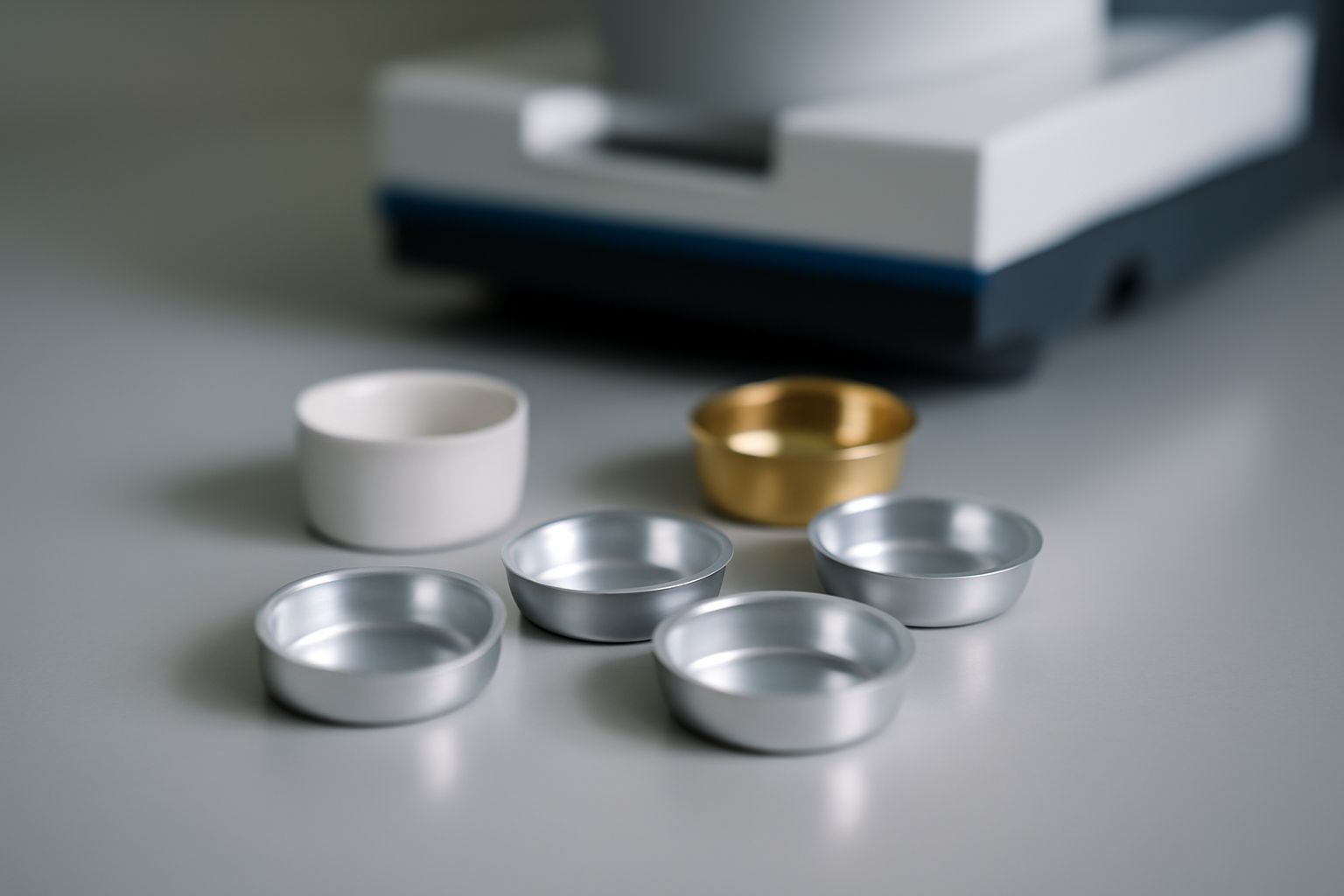
The technical specifications of DSC crucibles—such as material composition, capacity, temperature range, and design—determine their efficiency and reliability in different laboratory environments.
I have guided many teams through pan selection and troubleshooting. My experience shows that understanding specs upfront speeds up testing and produces higher-quality data—no matter the project or industry sector.
Different experiments demand different levels of purity and chemical resistance. Choosing the correct crucible material matches test needs and controls costs.
DSC crucibles come in high-purity aluminum, platinum, gold, and alumina (ceramic) to handle routine, high-temperature, or chemically aggressive applications.
| Material | Best For | Key Features/Reference |
|---|---|---|
| Aluminum | Daily polymers, food science, pharmaceuticals | Up to 600°C, high-purity, easy sealing (Aluminum) |
| Platinum | High-temp, strong acids or oxidizers, inert samples | To 1600°C, reusable, very low reactivity (Platinum) |
| Gold | Trace analysis, pharma purity checking | Inert, avoids sample contamination, costly |
| Alumina (Ceramic) | Environmental, soil, harsh alkali/acid | To 1700°C, strong chemical resistance, brittle (Alumina) |
When running tests on unknown or aggressive samples, I prefer alumina or platinum pans for peace of mind. Aluminum pans are my go-to for routine DSC on polymers or dry foods, providing a balance of cost and lab productivity.
Using crucibles that are too large or small reduces measurement accuracy. The right volume ensures good thermal contact and appropriate sample responses.
Select DSC pan capacity by considering sample mass, thermal signal strength, and sensitivity limits for your method or testing protocol.
| Pan Volume (µL) | Sample Type/Use | Tip/Reference |
|---|---|---|
| 10–20 µL | Trace samples, critical pharma, fast kinetics | Minimizes baseline drift, see DSC basics |
| 20–40 µL | Routine DSC, daily QA, synthetic polymers | Works for most common use-cases |
| 40–100 µL | Bulk powders, blends, adhesives, liquids | Check instrument limits and avoid overflow |
For high-sensitivity tests, I move to lower volume pans and set sample mass exactly. Large pans suit adhesives or chunky samples but can slow heating and reduce precision. Careful matching of pan and protocol boosts both accuracy and repeatability.
Exceeding rated temperatures leads to warping, melting, or failed test data. Temperature range is critical for DSC accuracy and instrument safety.
Each material of DSC crucible has a specific temperature range—aluminum (to 600°C), platinum (to 1600°C), alumina (to 1700°C). Always match test profiles and atmosphere for reliable use.
| Crucible Material | Max Temperature (°C) | Typical Applications | Reference |
|---|---|---|---|
| Aluminum | 600 | Foods, polymers, non-reactive QA | Aluminum |
| Platinum | 1600 | Advanced materials, metals, strong acids | Platinum |
| Alumina | 1700 | Soils, environmental solids, harsh reactions | Alumina |
I audit all new method setups with temp profiles to avoid breakdowns. When users see sudden loss of thermal signal, a check of peak process temperature and pan material usually points to the problem. Staying within limits adds both safety and cost-savings.
Small design cues—like sealing type or pan depth—impact sample prep, throughput, and measurement reliability as much as material or volume choices do.
DSC crucibles offer a range of designs, such as standard, hermetic, high-pressure, vented, and deep-dish, to suit specific sample types, prevent evaporation, and accommodate method variations.
| Design Feature | Key Benefit | Application/Advice |
|---|---|---|
| Hermetic Seal | Locks in moisture, limits contamination | Best for volatile or liquid-rich samples |
| Vented Pans | Relieves pressure, reduces risk of bursting | Useful in chemical decomposition series |
| High-Pressure Type | Enables testing under non-atmospheric conditions | Battery and specialty research |
| Deep/Wide Pans | Holds larger bulk or viscous samples | Polymers, adhesives, and complex blends |
Early in my career, switching to hermetic pans eliminated problems with water loss in food DSC. Now, I prioritize specific pan features based on anticipated sample volatility or test risk—especially for valuable or limited-quantity experiments.
Understanding the technical specs of DSC crucibles—from material and temperature rating to design detail—ensures reliable, safe, and optimized thermal analysis in all lab environments.
Contact Us: info@redthermo.com

C082.Wangdefu International Building, Furong, Changsha, Hunan, China


+86-19907415020