



SHOPPING CART
Your cart is empty.
shop now
Your cart is empty.
shop now
If your thermal analysis fails or gives erratic readings, the wrong sample pan could be your weakest link. Many overlook critical details that make all the difference.
Key specifications for a high-quality DSC pan include pure material composition, tight dimensional accuracy, wide temperature resistance, and robust seal integrity. Checking these specs ensures your data is both consistent and reliable.
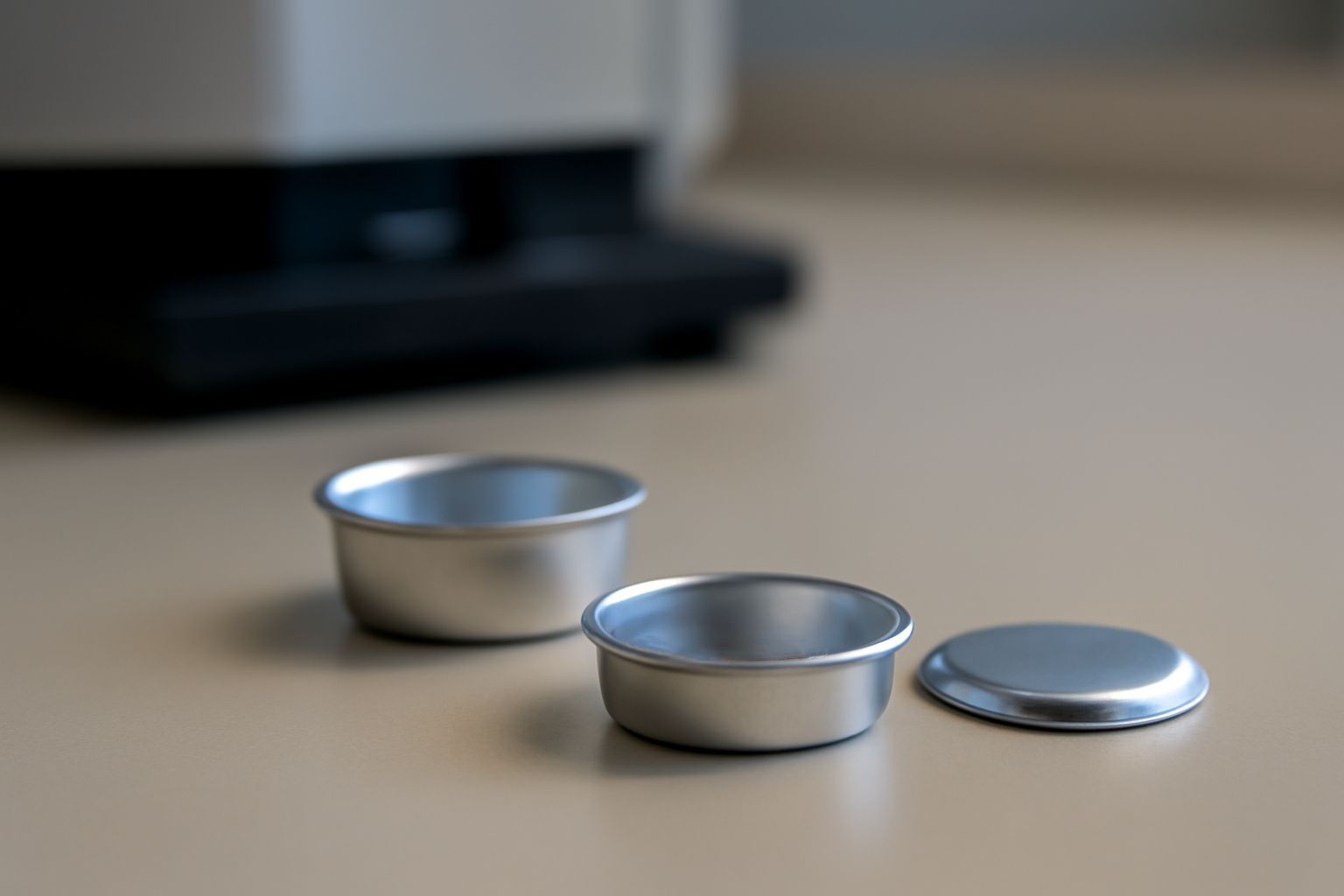
I have seen labs waste time troubleshooting unpredictable baselines because they missed core pan specifications. Once you pay attention to the material, size, temperature range, and seal, testing becomes much more consistent. Each part of a DSC pan matters. Reliable results depend on getting these features right. Let’s look at each factor step by step so you can avoid common pitfalls and raise your lab’s testing standards.
Pan contaminants or low-purity metals can interfere with results and lead to costly retests. Only the right material composition ensures accurate thermal measurement.
Material composition in a DSC pan must be selected for chemical purity, resistance to reaction, and optimal thermal conductivity. Pure metals like aluminum or platinum provide stable baselines and prevent unwanted sample interactions.
| Material | Key Advantage | Recommended Use |
|---|---|---|
| 99.99% Aluminum | Excellent thermal response and low cost | Most organic and inorganic sample analyses |
| Platinum | High temperature resistance, chemical inertness | Corrosive or high-temp samples, special reactions |
| PTFE or Gold-coated | Non-stick, protects sensitive samples | Volatile or sticky samples, special QA needs (quality assurance) |
DSC pans made from impure or reactive metals often cause noisy baselines or unreliable data. In one test, results shifted when a supplier used substandard aluminum. After switching to verified high-purity material, we saw a dramatic drop in baseline drift. Choosing the right material not only protects your data — it protects the value of your research. Always ask for certified purity before purchase.
Even a small error in pan size can cause uneven heating or contact loss with your instrument. Bad fit means unstable results and wasted samples.
Dimensional precision is essential as it guarantees the sample pan sits correctly in the instrument, allowing uniform heat flow and accurate calibration—both vital for solid and liquid analyses.
| Dimension Factor | Impact on Testing | Specification Standard |
|---|---|---|
| Diameter | Ensures contact with the sensor (calorimeter) | ±0.01 mm tolerance |
| Height/Depth | Controls sample volume, prevents overflow | Matches device specs exactly |
| Pan Lid Fit | Guarantees proper seal and prevents loss of volatile samples | Close-fit, no gaps, uniform pressure |
I remember a lab’s entire calibration going off because pan diameters were 0.03 mm off. The instrument lost sensitivity and baselines drifted. Only after switching to supplier-certified pans did their calorimetry data improve. Precision in pan dimensions makes a real difference to experiment success, especially if your standards are strict.
Pans that soften, sag, or react at test temperatures will ruin results and break workflow. I have seen projects delayed from overlooked pan temperature limits.
High-quality DSC pans must cover a temperature range wide enough to match the most demanding experiments, staying stable from cryogenic (cryogenic) to elevated heat conditions.
| Material | Temperature Limit | Suitable Test Types |
|---|---|---|
| Aluminum | -100°C to 600°C | Most general DSC work, polymers, pharmaceuticals |
| Platinum | -150°C to 1600°C | Ceramics, metals, high-performance composites |
| Gold-coated/Sealed | Depends on base; often to 300°C | Moisture-sensitive samples, lower-temp QA |
Data from ScienceDirect shows that failure to match pan capability with experimental temperature can compromise safety and results. I always check pan specs before planning stress or phase transition experiments, especially for research beyond ambient conditions. Wide-range certified pans boost reliability and reduce repeat testing.
Poor seals leak vapor or admit air, leading to off-target measurements or sample loss. Weak durability means more failed runs and wasted effort.
Seal integrity and pan toughness are vital for protecting sample mass, keeping atmospheric effects out, and supporting consistent test repeatability in both short and long-term studies.
| Seal Feature | Impact on Testing | Best Practices |
|---|---|---|
| Crimped Lids | Controls evaporation and sample weight loss | Uniform, tool-applied pressure; avoid manual errors |
| O-Ring, Snap Seals | Enhances repeatability, especially in moisture analysis | Choose compatible elastomers; check before use (elastomer) |
| Durability Under Cycling | Prevents warping after multiple tests | Source pans rated for your number of cycles |
In repeated drug or polymer testing, pan leaks ruined entire batches because of tiny defects. Now, I insist on robust seal tests and documentation from every pan supplier. According to ISO 11357, seal and durability checks are key to long-term testing success. This habit saves costs and boosts data trust for every experiment.


C082.Wangdefu International Building, Furong, Changsha, Hunan, China


+86-19907415020